

If a lesson emerges
... work with it

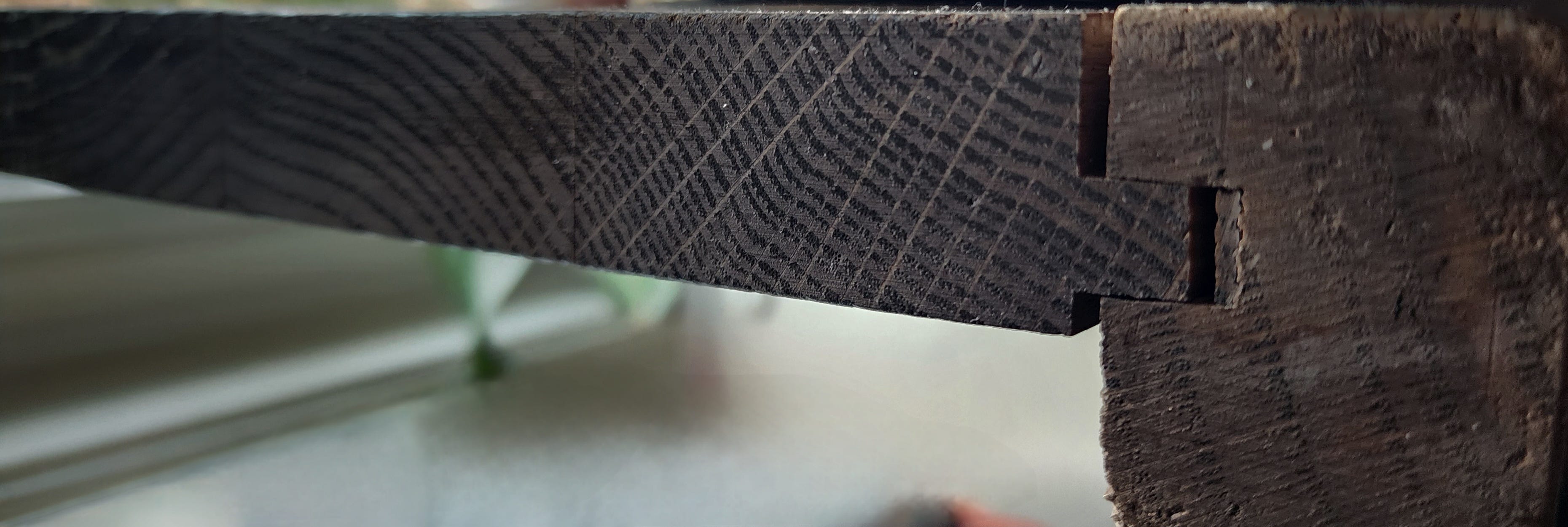
Determined to make something of it, at my insistence, the back of one of West Hill’s oak pews spent several years in my garage. It had been removed from the sanctuary along with all its siblings in order to create a more flexible space. This one piece – a short one from the choir loft, maybe? – had come home with me, the rest donated elsewhere – red oak no longer in vogue – most of them to the local high school shop class.
The seating had been installed in the 1960s when the church was renovated, two wings being added for much needed space in that church-burgeoning time. They were long, ergonomically-milled seats, stained a dark brown to match the brick of the walls. The design was a bit more attractive than it was functionally wise, however; the flat, ten-inch-tall backs, mounted about a foot above the seats as they were, left nowhere to tuck a coat but plenty of room to lose a rolling baby. Fortunately, a cloak area had been included in the new plans and only a smattering of coats ended up in the saltwater marshes that aggregate in Toronto’s winter sanctuaries. As for babies, I can’t be so sure, but I was always wary.

The pew back I’d held onto had languished in my garage those many years for lack of a plan as to what might be done with it. Every idea I came up with was either far above my skill level or beyond my equipment certification (I don’t have any). I could have turned it into a stair tread (for which it was amply suited, a small lip running along one edge - see photo) but I’d have had to build some place for it to take someone to, a place of arrival, a project well beyond the merit of a single, salvaged pew back, even one imbued with the nostalgic meaning this one holds for me. So, it stayed in the garage where winter salt soaked in under the door, rain dripped, and dust conspired with spiders to wrap its red oak in a grimy covering. Eventually, though I knew an industrial plane could return it to its former beauty, the piece became one of those many “projects” I’ve started with no clear plan in mind, and ended up becoming one of those many things whose presence is noted and queried in the once-a-year tidy-up-time, but otherwise stands silently out of mind.
My partner is obsessed with making me smile.
He’s always been like that, loving to do lovely things for me and enjoying the reaction. Cooking an outstanding meal and adding a panache to its visual presentation; setting up lights in the garden that enhance the plants in the summer and illuminate the bare branches in the winter. Taking the devastation of whatever it is I’ve broken and finding someone to restore it. And bringing me flowers, a favourite of which is orchids.

Bouquets of flowers are an enduring gift of choice because of their exquisite and incomparable beauty. Each bouquet is different, the selection of flowers and their arrangement in a chosen vessel creates something ephemeral, a reminder of the passing wonder embedded in beauty and joy.
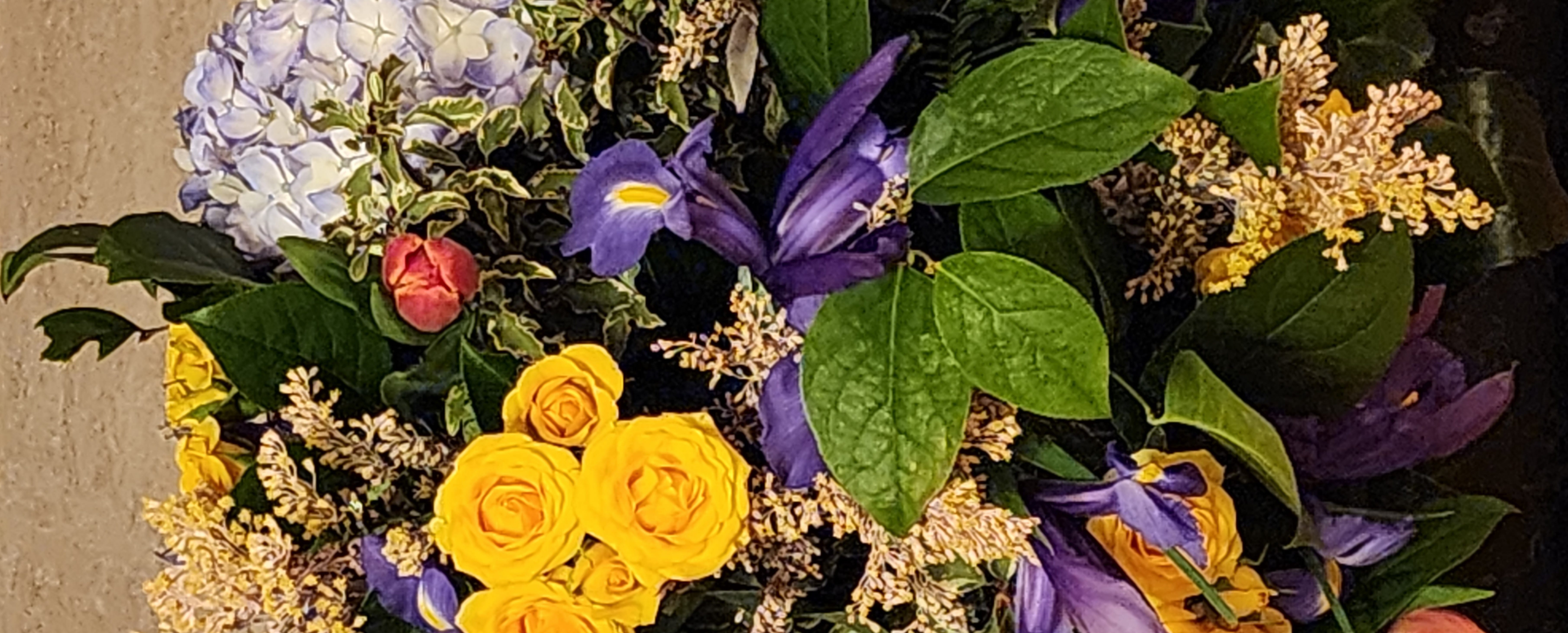
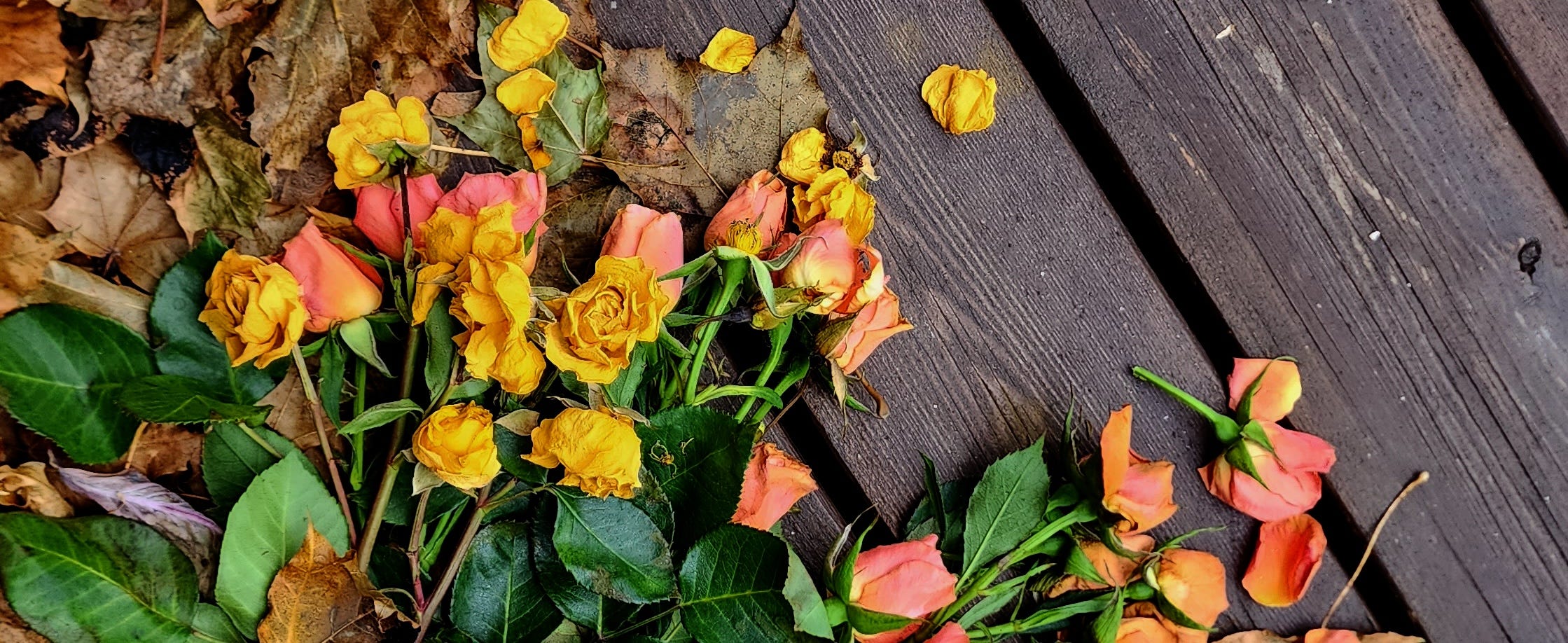
I’ve received gorgeous bouquets and arrangements over the years, from my partner, mom, children, congregation, and friends. They arrive at times of joy, sorrow, celebration, and loss, each a reminder of the transience of life and the need to celebrate and live the intensity of that particular moment. At their end-of-life, my ritual is to take them into the backyard and splay them out on the ground in one of the gardens, or sometimes just across the deck so that I can watch their beauty continue to transform over the days or weeks to come, the vase already washed and returned to the cupboard.
You can’t do that with orchids
If you know orchids, you know that they are exquisite in their prime and that, once blooming, they will do so for weeks, sometimes months. But when their flowers drop off, they are absolutely dead boring. But they’re not dead. I mean, there are no flowers, but the roots and the leaves, and even the stalk from which those flowers waved good morning to you over those oh-so-many weeks, are still alive. You can’t just toss them in the bin. Or throw them out into the garden. Or leave them to freeze or burn on the back deck. It’s just not right.
And so it is that, over time, I have accumulated more than a dozen orchids, fitting them into chipped antique cups and cracked pitchers, finding shelves or sitting them on the floor by a window, being careful to keep them from direct sunlight so they don’t get burned, repotting them after years of nothing but leaves, and being as patient as I could possibly be. And they may as well have been dead because nothing, absolutely nothing, happens.
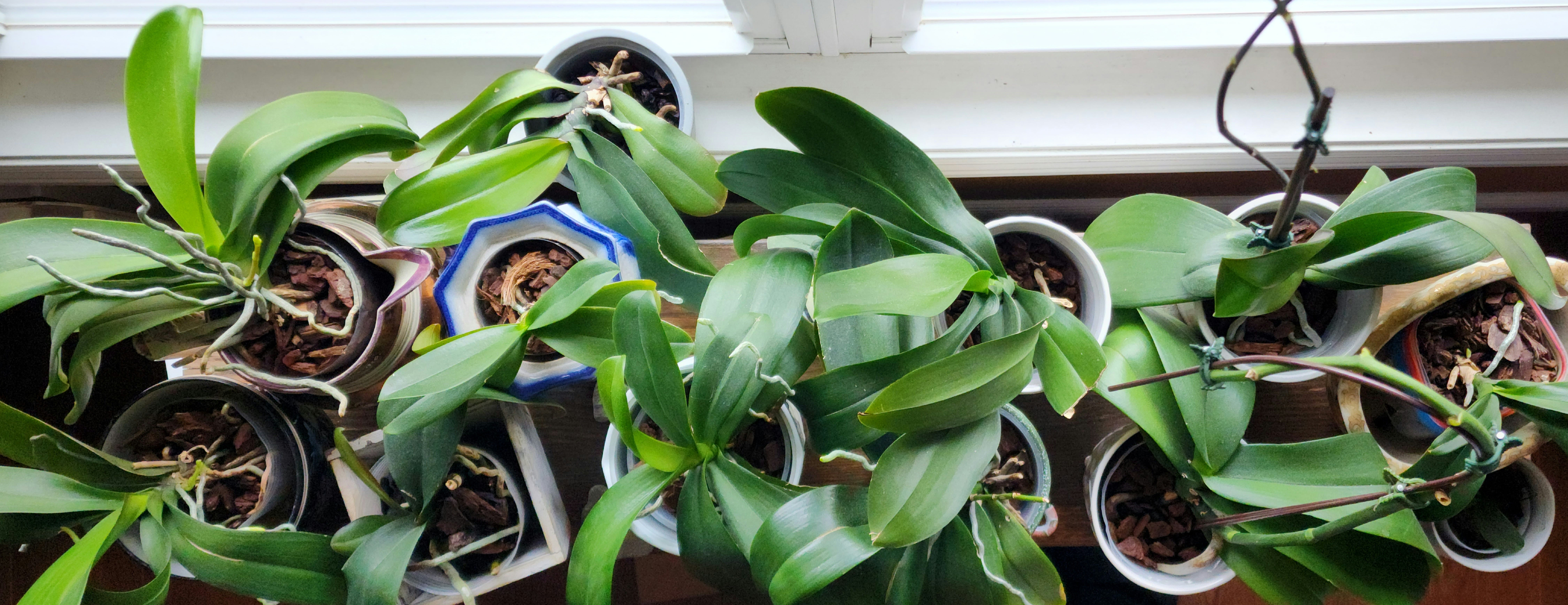
But a couple of years ago, the orchids found their purpose. In that year’s tidy-up-time, as the wisdom of keeping the aging, now-dingy oak pew back was again queried, the orchids became the reason-to-keep-it for which we had been searching! Requiring a north window, they now sit upon the pew back which rests, in turn, on an old bookcase (also badly in need of a home) where they have, unfortunately, continued to display their lacklustre will to survive and showing no appreciation for being encouraged to do so.
Stay with me, here; it’ll all make sense in a minute.
It has been a difficult year. Returning to work after an extended medical leave is challenging at the best of times. In the midst of congregational transition, it’s even more so because things are in already in motion, and motion means blurriness. I returned and was quickly brought up to speed about the new approach the congregation was taking toward its future. (It’s brilliant, by the way.) I took up the roles I’d previously filled – preaching, pastoral care, Board responsibilities and oversight. Neither I nor the congregation realized, however, that during the term of a supply ministry, the definitions of those roles had shifted, some of them being moved outside the position description, and contracted out separately. Eventually, we sorted it, but by that time, other stuff was at play.
Antidepressants are depressing
Five months into my return, my health was, again, failing. And, like my previous medical leave, it was a change in prescribed medication that seems to have precipitated it.
(I’ve written previously about antidepressants and their dangers; please read “Having said all that” for more information on them and their implications in my quest for wellness.)
I had learned much during my unsupervised and traumatic withdrawal from Amitriptyline (Elavil). It had been prescribed to reduce the number of migraines I experienced (a job it never did well), and I’d been on it for two decades with frightening consequences. So, I’d carefully planned my withdrawal from Venlafaxine (Effexor), something I needed to do because of distressing side effects I was experiencing. As I returned to work at the beginning of this year, I had successfully reduced the dosage to 39mg/day from 150mg!! I’d done so by dropping 10% of the current dose every three weeks (non-standard dosages are available through prescription at compounding pharmacies). And NO negative impact from the withdrawal!! Yay!! It was going to take another year to be totally off it, but things were going well.
In an effort to attend to recently diagnosed ADD issues, however, one of my doctors chose to replace the Venlafaxine with Bupropion (Wellbutrin). I made the switch at the beginning of May. Because the new medication was also an antidepressant, I was not prepared for side effects. Indeed, as I began having them – severe exhaustion, difficulty breathing, inability to walk distances or carry items up stairs, not enough breath to talk while walking – I attributed them to other things. Only after a visit to the emergency department and every test in the book indicating there were no imminent medical issues, did a cardiologist note the similarity of the symptoms to antidepressant withdrawal, a suspicion around which I had already been sniffing.
And so, while coming off antidepressants I shouldn’t have been on to begin with, I’ve become depressed as the result of the withdrawal, but also situationally. I’m coping with the realization that the last, irreplaceable five years of my career have been lost to irresponsible medication prescriptions and transitions that never adequately dealt with the presenting problem they were initiated to address: my migraine headaches, now relieved simply by taking vitamins, not antidepressants. Of course, I’m sad. But I’m still exhausted.

When we are unwell, we often don’t care for the things and people around us as well as we otherwise might do. Depression, whether induced by withdrawal from medication or other situational realities, is a category of unwell that makes it particularly difficult to care for anything. Indeed, rather than smiling when my partner brought me a delightful gerbera daisy a couple of weeks ago, I told him to stop bringing me plants. I simply cannot maintain them, not watering them until they make me angry for being so droopy, and if I manage to at all, doing so grudgingly. It’s like I’m angry they need anything from me. So he, promised by a salesperson, that it would require no care whatsoever, brought me an amaryllis that, in accordance with the instructions, I am totally neglecting. For that, I did smile. And it is already beginning to bloom.
Willful neglect
But I didn’t water the orchids. Not for well over a month, and then only in the way one does something because it “must be done” and for no other reason. No desire to keep them alive. No interest in protecting them. Certainly, no hope of a reward.
Maybe the slightest sliver of a “duty of care” had emerged. I mean, they’re orchids. In pots. It’s not like they can reach for that drop of water on the windowsill themselves. Besides, there’s no drop of water on the bloody windowsill, anyway. Maybe because watering the orchids might make me feel like I’d accomplished something. That’s my motivation for everything I do these days: feeling like I’ve done something, no matter how trivial. I’m depressed. And for good reason, thank you very much. Water yourselves, dammit. But I watered them. Eventually.

And then,
after years and years of careful tending,
the orchids,
left without water during my despair,
offered me their hope.
Seriously. Three of them. Even ones I’d cut the stems off before I’d learned that new blooms emerge most easily from existing stems. They put out new stems. N.E.W. stems! They are planning new blooms! And I know they are; I checked them carefully: they are definitely stems, not just more roots. Stems with little calyxes or whatever they are, out of which I am now confident new flowers will emerge.
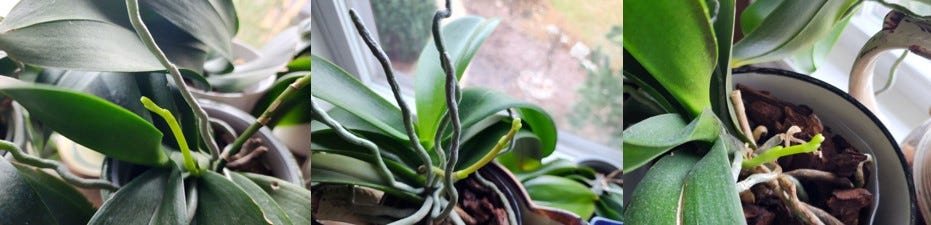
Out of these years of dormancy that have required constant care, lacking the structure out of which possibilities would normally emerge, these little crooked signs of hope.
And it seemed, to me, a lesson was emerging on the back of my battered pew as it held a wreck of orchids gathered over years and turning into wonder:
Being dormant is good but it isn’t the end. Allow it. Let your becoming endure it.
and I smiled.
…..
Thanks, Gretta. The Palestinians in Gaza and the West Bank must feel like those old orchids or even you at your lowest. Hopefully there will be new shoots blooming forth - maybe peace and a new Palestine. David Knoppert
I have been in awe of the magnificent amaryllis we received from a friend, which is now in full bloom. I find it hard to believe all of this energy and beauty were somehow wrapped up in its small onion-like bulb. Gives us all hope.