
Slain by poetry
… and the truths it inflicts

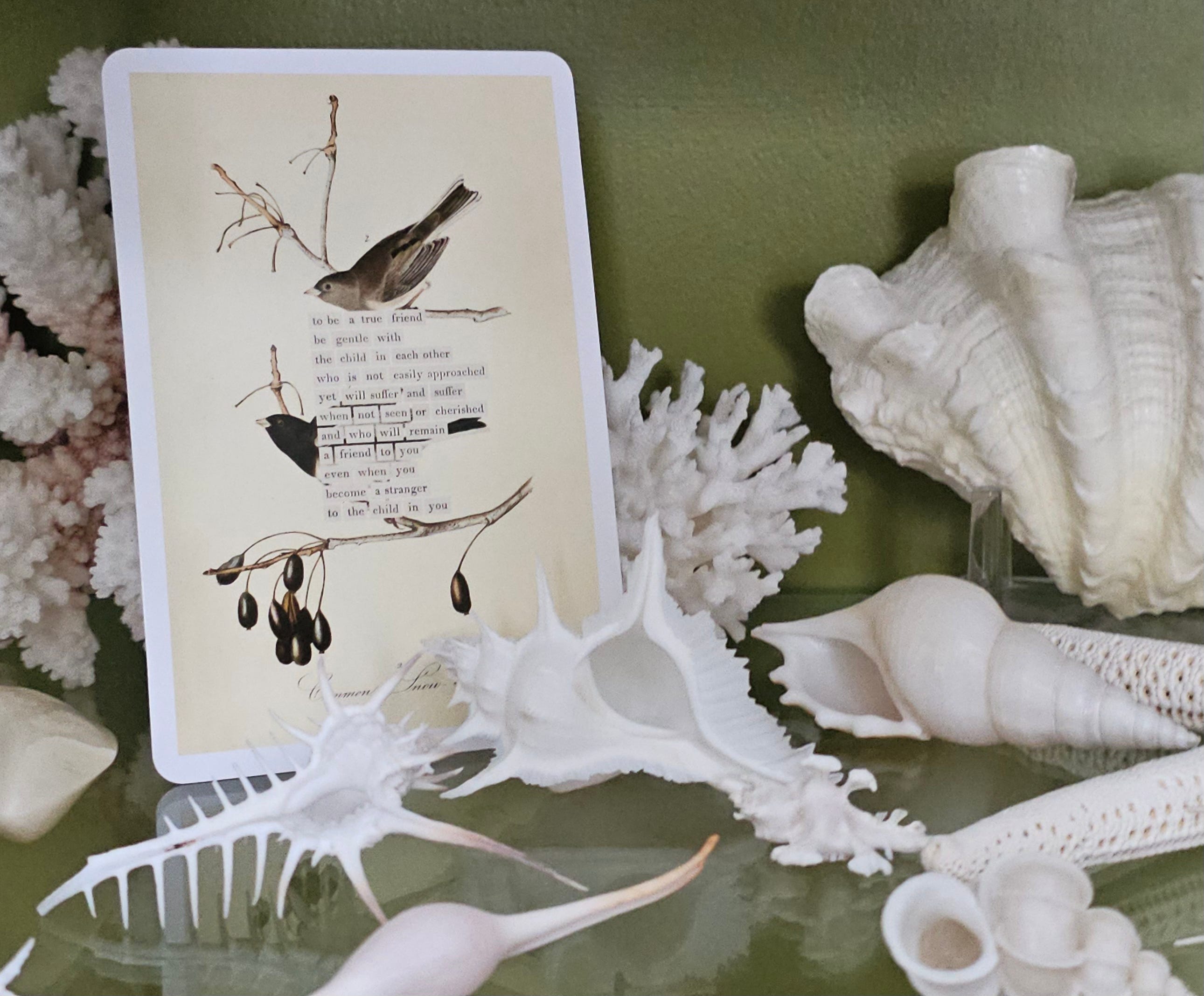
So, for the second time in the few days since taking up this challenge of writing on Maria Popova’s inspiring work with Audubon’s Birds of America, at the top of the page, I wrote out the poem as Maria had pasted it to the image of the Common Snow Bird and stopped, unable to gather my heart to the task, unable to read, to breathe through the truths and carry on as if it were simply a poem, as if it weren’t slaying me with its vision into my world, my childhood, my truth.
Still stopped ….
Stilll stopped …
Headed for chocolate (90% - for health reasons, right?), a “wellness” practice I must one day give up.
Wrote a bit.
Erased it. (this notebook does not tolerate erasing; it’s all about outpouring, so that’s not good.)
(And, as I transcribe this from my journal to the web, I am not in the same headspace I was when I wrote it. Do we ever return to the same place? Similarly, too, reflecting on our inner child is a different journey every time …. )
Perhaps we need to come with instructions. Perhaps the accumulated wisdom of the ages, like biology, could begin pasting itself into our DNA so that when we are born, we’re already, at least a little bit, able to save ourselves from whatever reality we’re dropped into. Perhaps, then, varied knowledge, birthed into a family through its children, would allow celebration of differing capabilities, interests, and capacities and each child, knowing and able to celebrate their own gifts, allowing them to move confidently into their family, into their first classrom, into their first group of friends, always knowing they’d be valued, seen, heard. Our inner child arriving pre-programmed with all the pluck it needed to survive childhood and grow into a rich and vibrant adult human being.
Seriously. That would’ve been helpful.
Instead, if conditions are stressed, parents overburdened, or one parent raising children alone, (even if in relationship, as was my mom), if there are challenges, if love is not the primary and ever-evident atmosphere of the home, we do not thrive. The inner child hides long before anyone goes looking for her, or long before he may have been saved.
Perhaps, had Maria more words to work with, the poem might also have invited each person to befriend their own inner child first, before anything else they learned to do. Something like an automotic, genetic-encoded introduction to oneself.
But we cannot do that, can we? Because that takes abstract thinking which is not yet developed. And the “inner child”, if nothing else, is certainly an abstract.
I usually include a file with the bird’s call so that you can listen to it. Some of Audubon’s drawings are confused in their identification so I have Kenn Kaufman’s The Birds Audubon Missed as a means to straighten things out if necessary. Unfortunately, even that text provides no clarity on what this particular bird is, but it is not something that, today, we would identify as a Common Snow Bird. If anyone knows what it is, please do let the rest of us know!
This post is an offshoot of my A Whole Lot of Broken Substack. It’s part of a series inspired by the artistic and poetic work Maria Popova offers in An Almanac of Birds: 100 Divinations for Uncertain Days. Each post includes a minimally edited version of the reflection I’ve written as a regular morning discipline in response to one of Popova’s cards.
Regarding the word divinations, in which I do not believe, this from Popova’s introduction to the collection: “I don’t believe in signs – I don’t believe that this immense impartial universe concerns itself with the fate of any one of us motes of stardust … But I do believe in omens. Omens are the conversation between consciousness and reality, between the self and the unconscious – a conversation in the poetic language of belief. … We make our own omens by the meaning we confer upon chance events, and it is the making of meaning that makes us human, that makes us capable of holding something as austere and total as the universe, as time, as love without breaking.”
Stay connected with Popova’s writing with her weekly review, The Marginalian.